
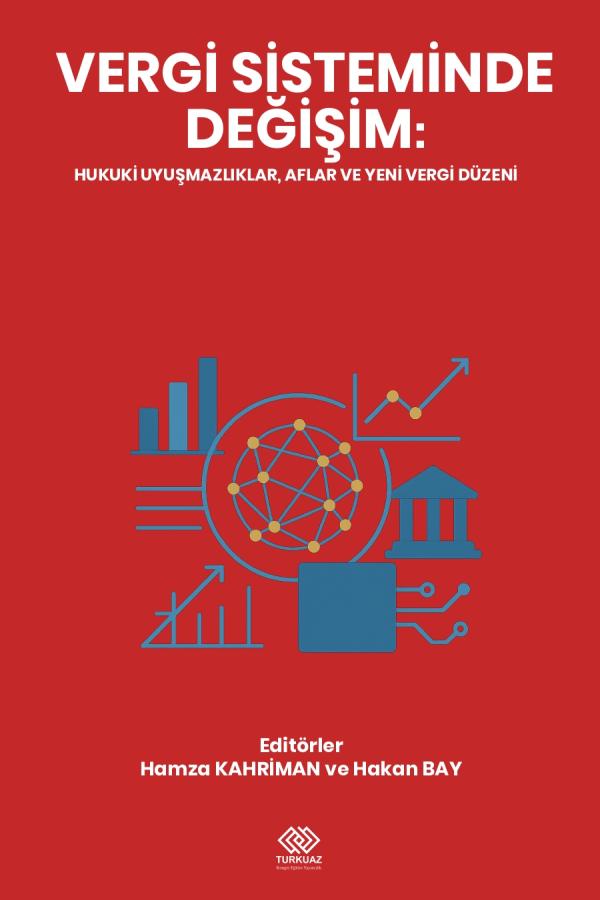
CHANGES IN THE TAX SYSTEM: LEGAL DISPUTES, AMNESTIES, AND THE NEW TAX REGULATION
Keywords:
Tax morale, Global minimum corporate tax, Tax amnesty, Simple regime , Objection and appeal commissions, Economic CrimesSynopsis
This book examines the transformation of the tax system in Türkiye along three main axes: the dynamics of legal disputes, the consequences of tax amnesties, and the emerging new tax architecture. Tax disputes are primarily evaluated in the context of tax jurisdiction, and three studies on tax jurisdiction are included in this scope. The first of these studies provides an assessment of how civil procedure rules should be applied in tax proceedings when administrative procedure rules are insufficient. Another study on tax disputes evaluates the tax objection and appeal commissions, which resolved some tax disputes in Türkiye before 1982, from a judicial perspective. This section includes discussions on why these bodies cannot be considered a court in terms of certain theoretical guarantees/concepts that a judicial authority should possess. Another study on tax disputes discusses the possibility of violating the right to a fair trial due to the absence of a detailed witness statement system, which is regulated in other branches of law, in tax jurisdiction, which has an autonomous structure in terms of its evidence system compared to other branches of jurisdiction. The common idea of all three studies on tax disputes is that the framework regarding general legal norms should be adopted with a broader perspective in reforms to be made in the field of tax jurisdiction.
The second axis of examination in this book is tax amnesties and their consequences. Tax amnesties, which are related to the issue of tax disputes discussed in the previous theme, form the basis of the discussion in this study, with evaluations suggesting that continuous regulations for tax amnesties not only lead to a decrease in tax revenues but also increase disputes between the administration and taxpayers. The first study related to the discussions on the re-formation of the tax system, which constitutes the third axis of the book's perspective, is the section that addresses the impact of economic crimes on tax crimes. Discussions on the Global Minimum Corporate Tax, brought to the agenda by the OECD regarding the erosion in national tax bases caused by the increasing capital mobility of multinational companies with globalization and digitalization processes, are also included in the book as another section. The section discussing the procedures followed in the taxation of the barber profession, an important profession in daily life, presents the differences arising from the preferred regulations in the formation of the tax structure through country comparisons.
The common premise of the book is clear: A permanent reform is possible not only through penal sanctions, amnesties, one-time incentives, or digitalization; but through regulations where justice, transparency, trust in the system and institutions are strengthened, individual behaviors are centered, tax culture is developed, and the language of legislation is made more understandable. Such a system will increase the sustainability of public revenues while rebuilding the balance between taxpayer rights and obligations on the basis of institutional legitimacy.
Chapters
-
THE IMPACT OF TAXES ON ECONOMIC CRIMES IN TURKEY
-
THE APPLICABILITY OF CIVIL PROCEDURAL PROVISIONS IN TAX PROCEEDINGS
-
GLOBAL MINIMUM CORPORATE TAX IN THE CONTEXT OF TAX THEORIES
-
TÜRKİYE’DE VERGİ AFLARININ VERGİ GELİRLERİ VE VERGİ UYUŞMAZLIKLARINA ETKİSİ
-
TAXATION OF BARBERS IN TÜRKIYE AND VARIOUS COUNTRIES
-
TAX OBJECTION AND APPEALS COMMISSIONS FROM A JUDICIAL PERSPECTIVE: A BRIEF EVALUATION ON THE HISTORY OF TURKISH TAX JUDICIARY
-
VERGİ YARGISINDA ADİL YARGILANMA HAKKININ TESİSİ BAKIMINDAN TANIK BEYANININ YERİ
Downloads
Published
December 16, 2025
Copyright (c) 2025 Prof. Dr. Hamza KAHRİMAN (Cilt editörü); Melisa ERDOĞAN ÖZKÖSEMEN- Çağrı Alihan ÇELİK- Prof. Dr. Yusuf KILDİŞ- Doç. Dr. Aytül BİŞGİN- Prof. Dr. Hakan ARSLANER- Prof. Dr. Hakan HOTUNLUOĞLU- Kübra BAŞ (Bölüm Yazarı); Doç. Dr. Hakan BAY (Cilt editörü); Doç. Dr. Pelin MASTAR ÖZCAN (Bölüm Yazarı)